
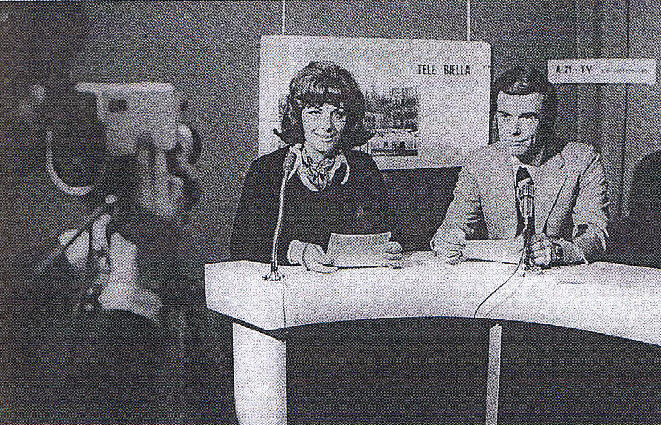
Telebiella is a television broadcaster, originally via cable, created in 1972 by Giuseppe Sacchi known as Peppo, former director of RAI, in a former boarding school located in the center of Biella.
The broadcaster was the second private Italian television to break the public monopoly of RAI, six years after Telediffusione Italiana Telenapoli di Napoli. In fact, Giuseppe Sacchi exploited a lacuna in the postal code which, dating back to 1936, did not contemplate the prohibition of the existence of cable television. Telebiella was therefore registered in court on April 20, 1971 as a “Periodical newspaper by video”.
Telebiella’s cable broadcasts were inaugurated on April 6, 1972 with an introductory message from Ivana Ramella, wife of Giuseppe Sacchi. Telebiella was a home-made broadcaster: Sacchi, with a portable video recorder, broadcast his own daily news.
Despite the focus on information, with news and talk shows, Telebiella also hosted the first non-Rai “light” show, the now historic Campanile in tub. Soon other cable broadcasters sprang up in various regions of Italy, sometimes with the help of Telebiella itself, or admittedly inspired by this one and by Telediffusione Italiana.
Clearly the reaction of Rai and the political world was not long in coming. The government issued the “Consolidated text on communications”, which unified all means of distance communication in a single category, thus making private channels illegal. Then, with the decree of 9 May 1973, the Minister of the Post Office, Giovanni Gioia, ordered the deactivation of the Sacchi plant, warning him to proceed within ten days (“Gioia decree”). The issue became of national political importance because the secretary of the Republican Party, Ugo La Malfa protested that he had been kept in the dark about the government DPR and asked for the resignation of Minister Gioia. He did not obtain them and withdrew external support for the government headed by Giulio Andreotti, who was forced to resign in the following month of June.
In the meantime, the post office had waited in vain for the deadline of 1 June; the owners did not comply with the order, so the decree was carried out: the cable that connected the broadcaster to the city network was severed. Telebiella then started a courageous legal battle. Sacchi had the brilliant idea of being denounced by a friend for violating postal regulations (because they violated the monopoly assigned to RAI). Newspapers told his story and cable TV was soon on everyone’s lips. All the media spoke of “Telebiella denounced”; the case was further expanded when the Pretore, Giuliano Grizi, interrupted the proceedings against Sacchi, and as the judge a quo raised doubt of unconstitutionality to the Constitutional Court. Which accepted most of Sacchi’s motivations and with a sentence of 1974 declared on cable television the constitutional illegitimacy of articles 1, 183 and 195 of the “Consolidated Law”, which reserved the television monopoly to the State. With a subsequent ruling also in 1974, he liberalized the placement on the national territory of repeaters of foreign television networks (French Antennas 2, TMC-Telemontecarlo, RSI – Swiss Italian-language radio and television and TV Koper-Capodistria). The following year the Parliament issued Law 103/75 (the “Reform Law”), which authorized single-channel cable broadcasts and also the repetition over the air on Italian territory of foreign broadcasters (France, Switzerland, Monte Carlo, Koper).

Telebiella resumed broadcasting via cable, flanked by an over-the-air radio channel, Radiobiella.
Important television personalities supported Telebiella, one of these was Enzo Tortora, then on a collision course with the state TV. Bruno Lauzi broadcasts a program dedicated to the history of song from the Telebiella studios.
In addition, Ezio Greggio, a native of Cossato, made his eighteen-year-old debut on this station, and later became a well-known television personality.