Studio 54
On April 26, 1977, STUDIO 54 opened at 254 West 54th Street. The venue offered extraordinary dreams: while everyone claimed that the quality of life was declining, Rubell and Schrager‘s club openly declared the opposite. Rubell called Siano to play on Wednesdays, Thursdays, and Sundays. At the time, discotheques were popping up everywhere and were becoming increasingly larger: Studio 54 was the emblem of all this—it was huge, it was the best, and it was the most flamboyant. 
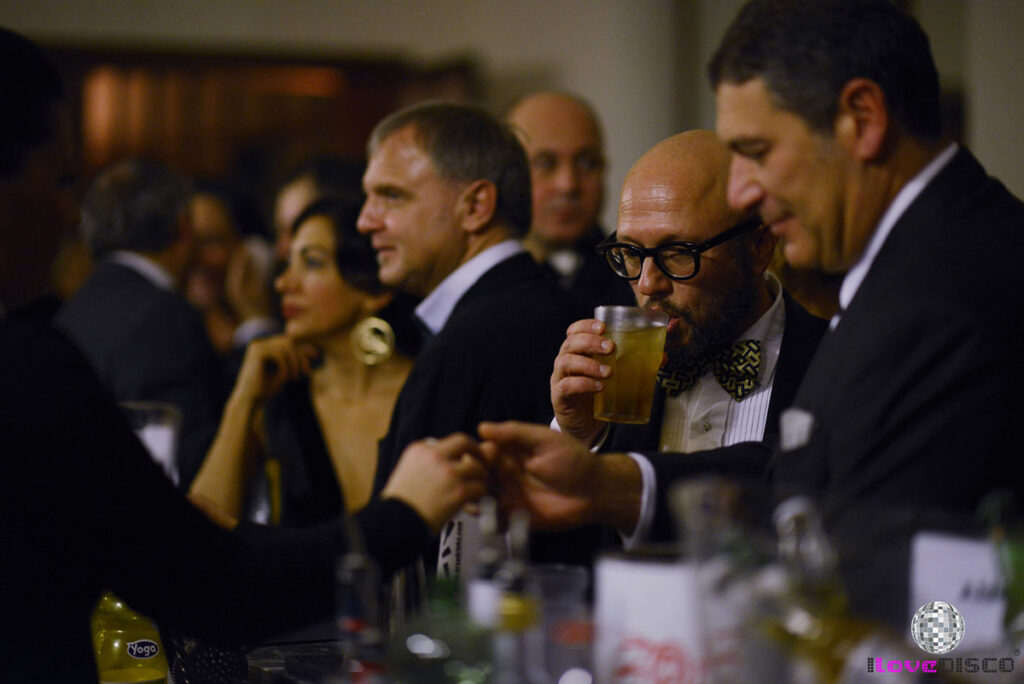
For the club’s inauguration, Rubell and Schrager were not so much concerned with the music as they were with the stars, the decor, and the paparazzi. When the doors opened, Cher, Brooke Shields, Bianca Jagger, Donald Trump, and Margaux Hemingway paraded across the dance floor. Due to the chaos outside, figures like Mick Jagger and Frank Sinatra were unable to enter the Studio.
THE SHOW BEYOND THE MUSIC
The party organized at Studio 54 for Bianca Jagger’s birthday is legendary: white balloons, flowers, and a white horse ridden by the birthday girl, all to attract even more clients and drive photographers wild! “From that moment on,” says Siano, “the Studio remained open six days a week, and every night it was packed.”
Carmen D’Alessio regularly organized themed parties for stars and fashion icons (Armani, Versace, Valentino…), theatrical and spectacular events that heightened the curiosity of regulars, but especially of those who could not get into the Studio. Over time, Rubell fell in love with his “VIP friendships,” his wealth, and his fame, and his use of drugs increased,  offering them in industrial quantities to the stars; he became arrogant and haughty, deciding who could enter and who could not from his position as the head of Studio 54. At the entrance, priority was given to stars, dancers, journalists, and gay people—essentially the “right types” to create atmosphere, class, and variety. Later, white gay men became the majority of the club’s clientele. Rubell and D’Alessio adopted David Mancuso’s invitation system but distorted it: memberships were sold at high prices. Those without a membership had to wait in line in front of Studio 54’s velvet rope: the perfect symbol of the politics of exclusion. Rubell carefully built the myth of an elite venue.
Tim Lawrence: “In reality, it was packed with ordinary and successful people who loved to think they were too clever to mix with other mere mortals. The velvet rope no longer blocked the way to the theater. It had become theater.”
Mancuso, after visiting Studio 54 for the first time, declared that he would never return: “People had to stand there hoping to be chosen. It was terrible. Studio 54 was not a place where you felt like socializing. I didn’t care at all about who was famous and who wasn’t. I wanted a place where things were spontaneous and relaxing: a place where you could be yourself without transforming. Studio 54 was very artificial. There were many distractions. They had an excellent sound system, but it was not a place for music.”
On December 14, 1978, federal agents raided Studio 54: during the search, they discovered bags full of cash. In November of the following year, Rubell and Schrager were arrested for tax fraud, sentenced to three and a half years in prison, and ordered to pay a fine of $20,000 each.